What if your dentist could design and create your dental crown, bridge, or aligner right in the clinic — while you wait? That's the promise of 3D printing in dentistry, and it's rapidly becoming reality.
How It Works
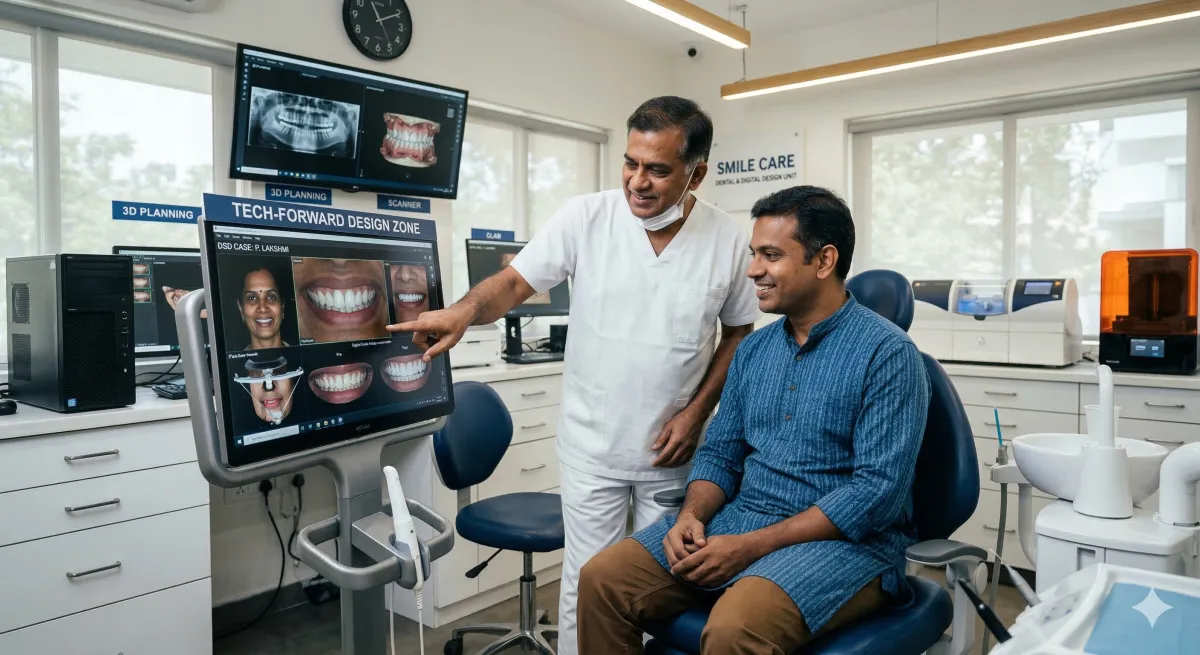
The process is straightforward: a digital scan of your teeth (no messy impressions) is used to create a precise 3D model on a computer. The dentist designs the restoration digitally, and a 3D printer fabricates it layer by layer — in resin, ceramic, or even metal.
What's Being 3D Printed Today
- Surgical guides for implants: Custom-printed guides ensure implants are placed at exactly the right angle and depth. This is already standard at advanced implant clinics — it dramatically improves accuracy and reduces surgery time.
- Clear aligners: Companies like Invisalign use 3D printing to manufacture custom aligner trays. Indian startups are now offering similar technology at lower costs.
- Temporary crowns and bridges: Can be printed chairside in under an hour while your permanent restoration is being made.
- Denture bases: 3D-printed dentures are more precise than traditionally made ones and can be produced faster.
- Night guards and retainers: Custom-fit guards printed from a digital scan — more comfortable than generic boil-and-bite versions.
- Study models: Replacing plaster casts with accurate digital-to-physical models for treatment planning.
Benefits for Patients
- Fewer visits: What used to take 2–3 appointments can sometimes be done in one
- Better fit: Digital precision means restorations fit more accurately
- No messy impressions: Digital scanning is faster and more comfortable
- Lower costs (eventually): As the technology matures, lab costs are expected to decrease
What's Next
Researchers are working on 3D-printed permanent ceramic crowns that match the strength and aesthetics of lab-made versions. Bioprinting — printing with living cells — may one day allow us to grow replacement dental tissue. We're not there yet, but the pace of innovation is remarkable.
Dr. Mani Sundar: "We already use 3D-printed surgical guides for complex implant cases. The precision is extraordinary — it's like having GPS for surgery. As the technology becomes more accessible, more patients will benefit."